Invoice-to-Cash Explained: How AR Is Becoming a Strategic Growth Engine


Why finance leaders are rethinking receivables – and how connected payments, data and workflows are reshaping cash flow, customer relationships and resilience
For B2B enterprises and government organizations, getting paid is no longer just a back-office function. It has become a strategic lever.
Rising costs are tightening budgets. Supply-chain disruptions and tariff policies continue to ripple through invoicing and fulfillment. Teams are leaner than they used to be. And customers, under pressure themselves, are stretching payment terms wherever they can. The result is familiar to most finance leaders: higher Days Sales Outstanding (DSO), more write-offs, more disputes and less working capital to invest in growth.
Against this backdrop, expectations are rising. CFOs and finance leaders are being asked to improve liquidity, reduce risk and deliver better customer experiences, all with fewer resources. This tension is exactly why Invoice-to-Cash (I2C) is changing from a reactive process into a connected, data-driven engine for visibility, resilience and growth.
What invoice-to-cash really is
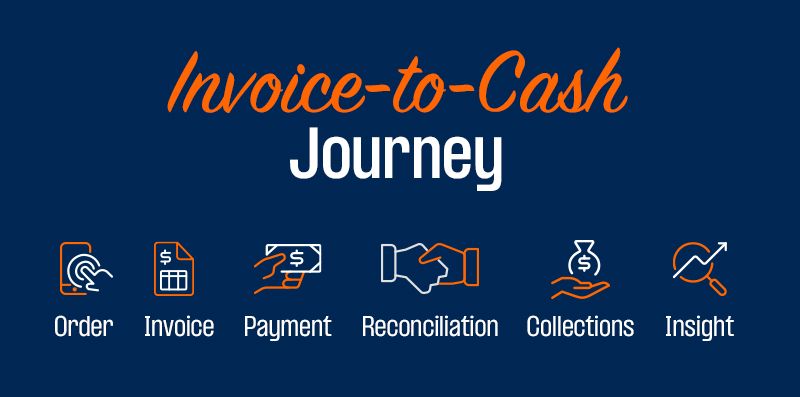
At its core, invoice-to-cash is the full journey of how revenue becomes usable cash: order, invoice, payment, reconciliation, collections and insight.
In many organizations, those steps still live in different systems, with separate teams and with various handoffs in between. Manual processes, physical checks, delayed invoices and fragmented data create friction at every point in the life cycle.
When the lifecycle is digitized and orchestrated end to end, I2C shifts from a series of tasks to a single, connected system. Electronic invoice presentment, self-service portals, integrated payment channels, automated reconciliation and predictive analytics create a closed loop that gives finance teams real-time visibility, earlier signals and far greater control over outcomes. This is the approach Fiserv has been building toward by connecting invoicing, payments, security, data and workflows into a single receivables ecosystem.
Why CFOs are paying attention
Late payments remain a working-capital challenge even for large enterprises. According to recent research by Creditsafe, 86% of businesses reported that up to 30% of their monthly invoiced sales were overdue. On top of this, 66% of the respondents said they’re typically waiting on up to $70,000 a month in overdue payments from customers. This puts considerable strain on their cash flow, supplier obligations and operational expenses.
And the consequences go well beyond the balance sheet. When AR is inefficient, teams spend too much time on low-value work, disputes linger longer than they should, and customer relationships can become strained. When AR is modernized, the opposite happens. Cash moves faster, disputes are resolved earlier, write-offs decline, operations are streamlined and trust improves.
Therein lies the strategic shift. AR is no longer just about collecting money. It’s about protecting revenue, preserving relationships and strengthening the financial core of the organization.
Omnichannel orchestration as the new standard
Modern I2C is built around flexibility for customers and for internal teams.
That means supporting cards, ACH, digital wallets, IVR, portals, APIs and call-center payments within a single, coordinated framework. It also means intentionally moving away from paper and checks, which increase processing costs, add days to DSO and raise fraud and reconciliation risk.
When customers can easily view invoices online, receive proactive notifications, log disputes digitally and choose how and when to pay, including scheduled payments or autopay, payment behavior improves. Digital adoption becomes measurable. And organizations can guide customers toward lower-cost, lower-risk channels such as ACH, or accessing credit with embedded financing.
Fiserv enables this orchestration by bringing together experiences, APIs, payment acceptance, security and compliance into one integrated experience.
For government and regulated entities, these same utilities support managed service fees and compliant surcharging programs to help offset processing costs while maintaining transparency and trust.
From reactive to predictive: the intelligence layer
Automation fixes today’s inefficiencies. But intelligence prepares organizations for tomorrow’s risk.
Advanced analytics and machine learning are shifting AR from a rear-view-mirror function to a forward-looking one. Predictive models can surface early warning signals, estimate propensity to pay and identify which customers are trending toward higher risk – long before an invoice becomes severely overdue.
These actions enable organizations to focus collector bandwidth where it has the greatest impact, engage at-risk customers earlier and more constructively, forecast cash flow with greater confidence and reduce bad debt without damaging relationships.
Fiserv’s analytics layer is designed to turn payment and invoice data into practical insight so teams can move from reacting to anticipating problems.
Best practices for ERP-integrated modernization
The most successful transformations do not start with ripping and replacing core systems. They start with integration.
In ERP-centric verticals such as manufacturing, logistics, utilities and government, the biggest gains come from connecting invoicing, payments, reconciliation and analytics directly into systems of record. This preserves data integrity, reduces manual rekeying, minimizes errors and supports faster, cleaner closes.
In practice, leading organizations focus on embedding payments into order entry and fulfillment, digitizing invoice delivery and dispute management, and automating payment matching and ledger reconciliation. They also use dashboards to monitor DSO, disputes, write-offs and digital adoption, while layering analytics on top to drive continuous improvement.
Fiserv has focused on building these capabilities in a way that fits into existing enterprise and government environments rather than forcing wholesale replacement.
The strategic future of invoice-to-cash
The future of invoice-to-cash is not about speeding up an old process. It’s about rethinking how financial operations support the business as a whole. As volatility becomes the norm and expectations continue to rise, AR is emerging as a strategic lever rather than a back-office function. The organizations that manage in this way will be better positioned to forecast risk earlier, respond more quickly to change and create the financial resilience that growth now depends on.

Explore related resources