Agentic Commerce Is Here: What Merchants Need to Know and Do


How AI-powered agents are already reshaping commerce, and how merchants can prepare to protect identity, loyalty and payments
“Book me a weekend trip to Austin under $600.”
Not long ago, that request would have sent a consumer on a familiar journey: search results, comparison sites, filters, carts and, finally, checkout. With the emergence of AI applications, an AI agent will soon handle that entire process – searching, comparing options, applying preferences and completing the purchase – without the shopper ever touching a traditional eCommerce site.
That shift is what people mean by agentic commerce: AI agents acting on behalf of consumers to discover, evaluate and sometimes purchase products automatically.
“Historically, it’s always been you the consumer behind the screen,” said Hersh Mansukhani, Global VP of Product at Fiserv. “Agentic commerce changes that. Now, it’s your agent doing the shopping for you.”
For merchants, it’s exciting. But it can also be unsettling.
“Merchants know this is happening,” Mansukhani said. “They don’t want to miss out. But they’re also not sure what to do, or how much to invest.”
Read on to learn what agentic commerce really means for merchants, and how Fiserv believes the ecosystem needs to evolve.
Agentic commerce is exciting for merchants, but it can also be unsettling
What merchants want to know about agentic AI
For merchants, the promise of agentic commerce and shopping directly from AI applications is real, but so are the risks. Behind the headlines about automation and “frictionless” experiences are practical, urgent questions about what gets lost when a machine, not a customer, sits between a brand and the buyer.
One of the most immediate concerns is visibility: Will I still know my customer? In traditional digital commerce, merchants rely on a rich layer of behavioral signals – including device data, session activity, time-on-site, browsing paths and tender choice – to understand intent and personalize experiences. In agent-driven interactions, that layer disappears almost entirely.
“You’ve spent years learning how a customer shops,” said Mansukhani. “You know their device, their patterns, how they move through your site, what they like to buy and how they like to pay. Now it’s their agent. You don’t know anything about the person behind that shopping journey.” Without those signals, merchants worry they’re flying blind just as the channel is shifting.
That loss of visibility spills directly into another challenge: What happens to loyalty points, gift cards and private-label cards, for example? “Merchants drive repeat spend through things like private-label cards, gift cards and loyalty points,” Mansukhani explained. “But today, in most agentic experiences, those tender types don’t exist.” As agents become the new front door, today’s early models may further sideline industries that transact outside traditional card rails – such as utilities, insurance, education and subscription services, which already rely heavily on alternative payment methods and direct pay-by-bank relationships.
Closely tied to limited tender types is the cost of acceptance. Large merchants spend years optimizing how transactions are routed behind the scenes, often leveraging smart, uplift-driven, or lower cost strategies. “This is why Fiserv is working with conversational AI platforms to introduce routing optimization across schemes and alternative payments for agentic transactions, for both SMBs and enterprise merchants. The goal is to create an experience that works as smoothly for merchants behind the scenes as it does for users up front, enabling agent‑driven commerce to scale and become truly real.
As new AI platforms and protocols proliferate, merchants face increasing integration demands. “There are too many emerging standards and too much uncertainty for merchants,” Mansukhani said. “Merchants don’t have endless R&D budgets. They don’t want to build five or ten different integrations.” What merchants are really asking for isn’t just access, but a hedge – one multi-protocol solution that lets them tap into agentic commerce regardless of platform. As payments industry experts, our job is to make protocol adoption no different than any other network or message structure adoption.
Security is another important area to address. We’re introducing a new actor – the agent – in the purchase journey between shoppers and merchants. At Fiserv, we see this new party as an opportunity to introduce more objectivity and reduce buyer’s remorse and friendly fraud. Defining clear industry-wide roles and guardrails – so signals around identity, device and intent are consistent, and transaction context are easily understood by issuers – will transform agentic commerce from assisting human shopping to unlocking true efficiency, much like what we see in software development, ultimately enabling fully agent-driven use cases, such as high-frequency or repeat B2B transactions, for example.
Merchants have often worked for years to create cohesive, intentional journeys. In an agent-driven world, that continuity could fracture. “We want a world where, if your agent builds a cart somewhere, it shows up when you go to that merchant directly,” Mansukhani said. “That continuity matters.” Without it, the relationship between brand and customer weakens, replaced by a series of disconnected, third-party interactions.
Taking a merchant-first approach
Fiserv’s position is rooted in advocacy for merchants and our approach focuses on three core principles:
1. Preserving identity, loyalty and tender preferences
Agentic commerce should not break the systems merchants use to recognize and reward customers. Loyalty points, private-label cards and gift cards should have room to function inside agent-driven experiences.
2. Democratizing access
Without shared infrastructure, only the largest merchants can afford to build direct integrations. “If it’s left to bespoke integrations, you’ll end up with agentic commerce only for the top brands,” Mansukhani said. Through integrations such as Commerce Hub and platforms like Clover, Fiserv is working on enabling all merchants, including enterprise, mid-market and SMB, to participate.
3. Connecting the ecosystem
Fiserv acts as the connective layer between merchants, issuers, networks and AI platforms. This includes support for multiple emerging standards and enabling transparency and simple user experiences, such as ensuring cardholders and issuers know and can look back on which transactions were agent driven for a given statement period.
How to implement a merchant-first approach
Preserving identity, loyalty and tender preferences
Democratizing access
Connecting the ecosystem
What merchants can do to prepare for agentic AI right now
Even if fully agent-driven commerce still feels a way off, there are smart, practical steps merchants can take now to get ready:
- Clean up product and inventory data
Well-structured feeds make inventory discoverable by agents.
- Map loyalty and tender logic
Know how your systems work before extending them and map your customers' tender types and other data to your customer profiles.
- Choose adaptable partners
Merchants don’t need five integrations. They need the right one. Work with partners that can help you prepare for the future as standards emerge and evolve.
- Test and learn
The market is moving fast, and can be expected to evolve quickly. Get in the market to get a front row seat so you can test and learn about what works and what does not – agentic commerce will likely find its home in certain verticals, SKUs, types of purchases first.
The path forward in the age of agentic AI
“Agentic commerce is a generational change in how shopping happens,” Mansukhani said.
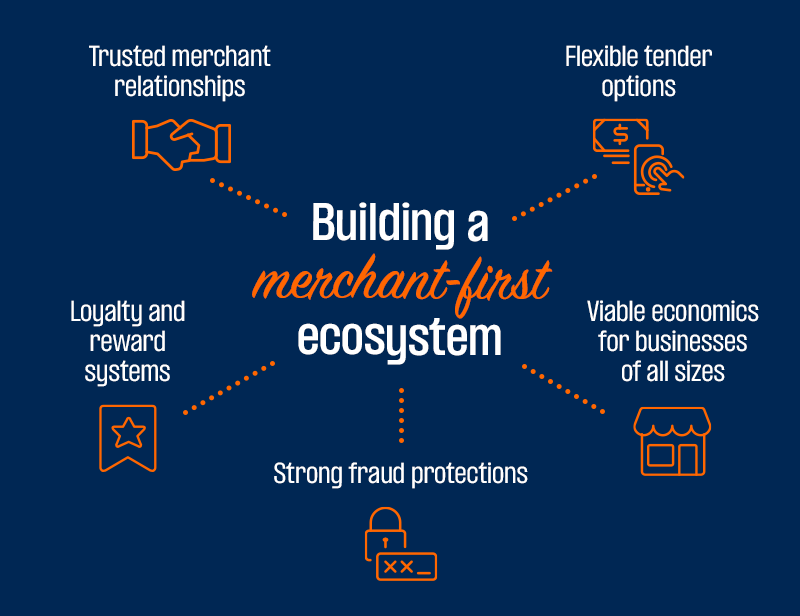
For that kind of change to work at scale, the ecosystem can’t be built around speed alone. It has to be designed to preserve the elements that make commerce work in the first place: trusted merchant relationships, flexible tender options, loyalty and reward systems, strong fraud protections and viable economics for businesses of all sizes.
Merchants don’t need to flip a switch overnight. But they do need a clear, intentional strategy for how they want to show up in this new world, what they’re willing to open up and what they need to protect.
“Someone has to make this merchant-friendly,” Mansukhani said. “That’s the job we’re stepping into.”
The future of commerce will include agents. The question is whether it will also include merchants in a meaningful and merchant-friendly way.
Fiserv’s bet is that it can and should.
Explore related resources